

Introduction
The rapid pace of technological innovation in the 21st century has given rise to transformative digital paradigms that are reshaping the way humans interact, communicate, and conduct business. Among the most disruptive of these are Augmented Reality (AR) and Blockchain — two technologies that, while originating from distinct conceptual domains, are increasingly converging to create a synergistic foundation for future digital ecosystems. AR blends digital content with the physical world, enhancing perception and interactivity, while blockchain ensures decentralized, immutable, and transparent data management. As these technologies mature, their integration promises to redefine industries such as gaming, retail, healthcare, real estate, education, and supply chain management.
The global AR market, valued at over $40 billion in 2024, continues to expand rapidly as consumer and enterprise adoption accelerates. Simultaneously, blockchain’s global footprint has moved far beyond cryptocurrencies, driving innovation in data integrity, digital ownership, and decentralized applications (dApps). Together, AR and blockchain hold the potential to build a future where digital and physical realities merge seamlessly — with security, transparency, and authenticity as core pillars. This essay explores their synergistic relationship, cross-industry implications, and long-term future prospects, shedding light on how this integration could transform our digital experiences and economic models.
The Synergy Between Augmented Reality and Blockchain
1.1 Understanding the Core Principles
To appreciate the synergy between AR and blockchain, it is essential to understand their fundamental architectures. Augmented Reality overlays computer-generated information — images, sounds, text, and 3D objects — onto the real world in real time. This fusion enhances user perception and interaction, offering immersive experiences in fields ranging from entertainment to industrial training. The primary challenge, however, lies in the management of digital assets, user identity, and data integrity within these immersive environments.
Blockchain, on the other hand, is a distributed ledger technology that provides a decentralized, transparent, and tamper-resistant way to record transactions and data. Each block in the chain is cryptographically linked to the previous one, ensuring immutability and trust without reliance on centralized intermediaries. When applied to AR ecosystems, blockchain can help solve major issues such as content verification, digital ownership, data privacy, and value exchange within virtual environments.
1.2 Complementary Strengths
The integration of blockchain with AR brings complementary strengths that amplify each technology’s potential. In AR applications, data authenticity and ownership are often questioned, particularly in decentralized content creation environments. Blockchain addresses this by providing a verifiable ledger of ownership and provenance. For example, an artist who creates a 3D digital sculpture for an AR exhibition can tokenize their work as a non-fungible token (NFT) on the blockchain. This ensures transparent ownership, traceability, and monetization without reliance on centralized platforms.
In turn, AR enhances blockchain’s usability and visualization. Traditional blockchain interfaces are abstract and technical, often confined to textual transaction data. AR can transform this by visualizing blockchain data in interactive, spatial ways. For instance, users can view live blockchain transactions as 3D visual overlays or interact with decentralized applications through immersive AR dashboards. This not only improves user comprehension but also increases engagement and adoption.
1.3 Enabling Trust in Immersive Environments
Trust is a cornerstone of digital transformation. As AR applications expand into healthcare, finance, and commerce, ensuring data integrity becomes paramount. Blockchain provides this trust framework by guaranteeing that data rendered in AR is accurate, verified, and unaltered. Consider AR navigation in smart cities: a blockchain-backed system can verify that environmental data, directions, or local business information are authenticated sources rather than manipulated content. This ensures trustworthy augmented experiences, particularly as deepfakes and misinformation proliferate in digital spaces.
Furthermore, blockchain can establish secure digital identities within AR ecosystems. Through decentralized identity (DID) solutions, users can control how their personal data is shared in AR interactions. This self-sovereign identity model strengthens privacy, reduces data breaches, and enables seamless authentication across applications.
Cross-Industry Applications and Transformative Impact
2.1 Gaming and Entertainment
One of the earliest and most dynamic intersections of AR and blockchain is in gaming and entertainment. Popular AR-based games such as Pokémon Go introduced millions to the concept of interactive digital overlays on the physical world. However, the centralized ownership of in-game assets limited player control. By integrating blockchain, developers can enable true digital asset ownership, allowing players to buy, sell, or trade in-game items securely as NFTs. This creates player-driven economies where value is not confined to a single game ecosystem but transferable across virtual worlds.
Metaverse projects like Decentraland, The Sandbox, and Illuvium are pioneering this integration, offering immersive AR-compatible environments where land, avatars, and accessories are blockchain-verified assets. AR enhances the experience by projecting these digital worlds into physical surroundings, blurring the lines between real and virtual existence. Such integrations not only revolutionize gameplay but also redefine entertainment as a participatory, creator-driven economy.
2.2 Retail and E-Commerce
In retail, AR has already transformed consumer engagement by enabling virtual try-ons, product visualization, and interactive marketing. Blockchain further enhances this transformation by introducing traceability, transparency, and authenticity verification into supply chains. A customer using an AR app to view a designer handbag, for instance, could also access blockchain-based certification of its authenticity, manufacturing details, and ethical sourcing. This fusion combats counterfeiting — a multibillion-dollar issue — while strengthening consumer trust.
Moreover, blockchain-based loyalty programs integrated with AR experiences can personalize shopping in novel ways. Shoppers could earn crypto tokens through AR-based store interactions, such as scanning products or participating in brand challenges. These tokens could then be redeemed across partner ecosystems, creating a borderless, transparent loyalty network.
2.3 Healthcare and Education
The healthcare and education sectors stand to gain immensely from the convergence of AR and blockchain. AR provides immersive visualization and simulation tools for medical training, surgical planning, and patient education. Blockchain ensures secure and verifiable medical data sharing across institutions, eliminating duplication and safeguarding privacy. Imagine a doctor using AR glasses to view a patient’s 3D anatomical scan while the underlying medical records are validated through blockchain to ensure authenticity and prevent tampering.
In education, AR transforms learning by bringing abstract concepts to life — students can explore 3D molecules, historical reconstructions, or celestial simulations. Blockchain complements this by enabling verifiable credentialing and secure record-keeping of academic achievements. Students’ qualifications can be stored as immutable blockchain records, ensuring authenticity and facilitating seamless global recognition. This combination supports a transparent and lifelong learning ecosystem.
2.4 Real Estate and Urban Development
In real estate, AR allows potential buyers to visualize buildings and interiors before construction. When paired with blockchain, this capability extends into secure property transactions, smart contracts, and tokenized ownership models. Blockchain ensures transparency in title management and prevents fraud, while AR enhances user engagement through immersive property previews. For urban planning, blockchain-backed AR systems can support data-driven smart cities, where digital twins of infrastructure are continuously updated and authenticated on the blockchain to ensure data integrity.
2.5 Supply Chain and Industrial Applications
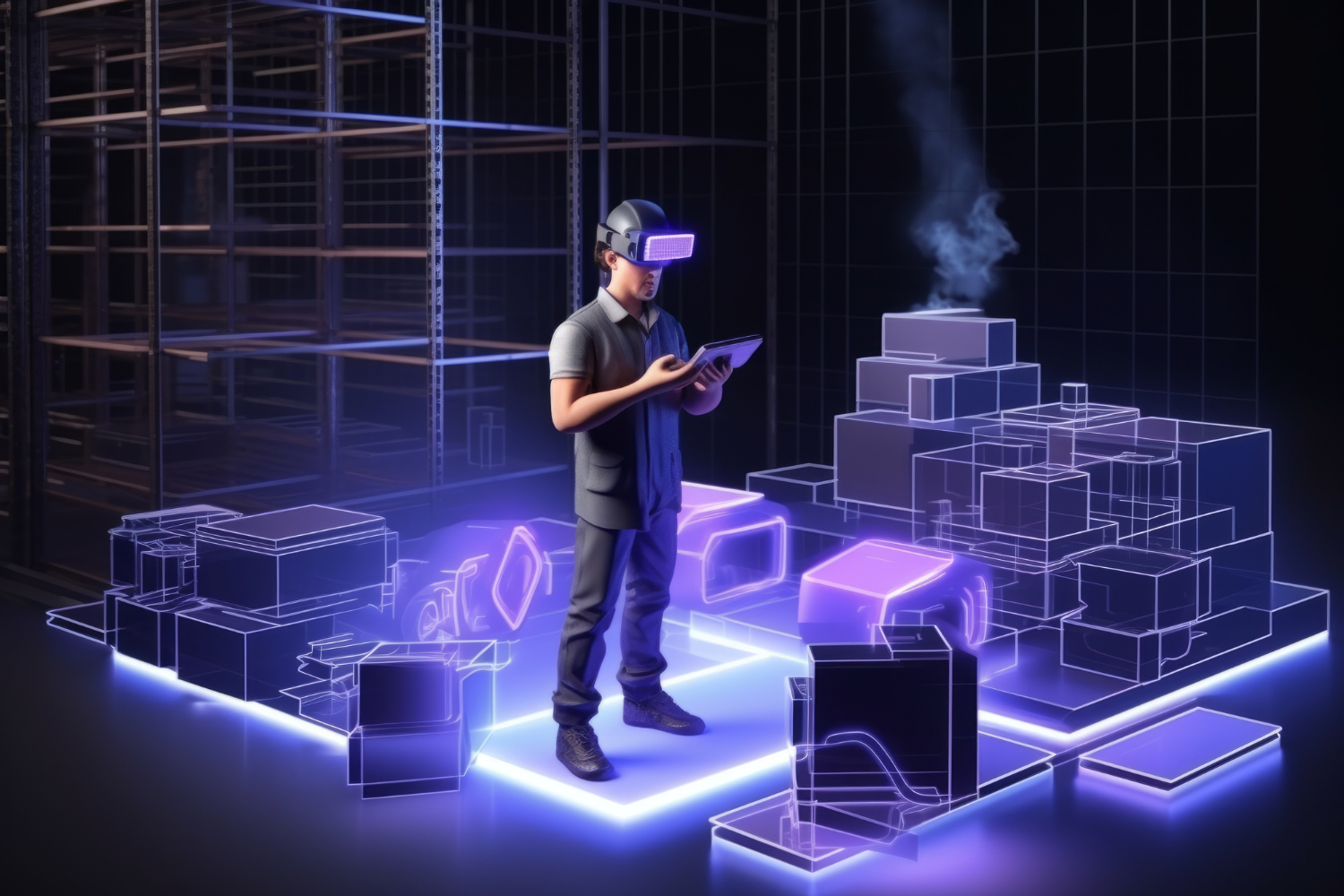
Supply chains are complex, multi-tiered systems where transparency and accountability are often lacking. Blockchain’s immutable record-keeping enables end-to-end traceability of goods, while AR facilitates real-time visualization of logistical data. For instance, warehouse staff equipped with AR devices could instantly access blockchain-stored information about product origins, shipment history, and handling requirements. This integration reduces human error, increases operational efficiency, and builds consumer confidence in product authenticity.
In industrial manufacturing, AR-powered maintenance and training solutions can be enhanced through blockchain to record maintenance logs, certification data, and part histories in tamper-proof ledgers. This ensures regulatory compliance and auditability, particularly in aerospace, pharmaceuticals, and energy sectors.
Challenges, Innovations, and Future Prospects
3.1 Technical and Infrastructural Challenges
Despite the promise of AR and blockchain integration, several challenges impede large-scale adoption. AR requires high computational power, low-latency connectivity, and precise environmental mapping, all of which demand robust hardware and 5G infrastructure. Blockchain, meanwhile, faces issues related to scalability, energy consumption, and transaction speed. Integrating the two compounds these challenges, as real-time AR experiences depend on instantaneous blockchain validation — a technically demanding requirement.
Moreover, data privacy and interoperability remain major concerns. AR devices continuously capture sensitive real-world data, which must be managed securely. Blockchain’s transparency, while valuable for trust, can conflict with privacy regulations such as GDPR. Developing hybrid systems that balance transparency with confidentiality will be crucial.
3.2 Emerging Innovations and Research Directions
Ongoing research aims to overcome these limitations through Layer-2 scaling solutions, zero-knowledge proofs, and edge computing. Layer-2 technologies such as Polygon, Arbitrum, or Lightning Network can reduce blockchain transaction times, making them viable for AR interactions. Edge computing brings data processing closer to the user, reducing latency in AR experiences while securely syncing data to blockchain networks.
Additionally, AI-driven optimization is expected to play a pivotal role. Artificial intelligence can automate blockchain transaction management, predict AR rendering needs, and secure networks through anomaly detection. The integration of AI, AR, and blockchain could lead to self-regulating ecosystems capable of learning and adapting dynamically — a cornerstone of next-generation digital environments.
3.3 Economic and Social Implications
The convergence of AR and blockchain could also reshape economic and social paradigms. It is driving the emergence of Web3 economies, where users not only consume content but also own, create, and trade value across decentralized platforms. Digital assets, virtual real estate, and tokenized experiences will fuel a new wave of digital entrepreneurship. Moreover, AR-blockchain ecosystems can democratize access to markets by reducing intermediaries, enabling peer-to-peer economic models.
From a societal perspective, this integration could influence how individuals perceive reality, identity, and ownership. The rise of phygital assets — items that exist simultaneously in physical and digital forms — may redefine consumer culture, blending tangible and virtual value. For instance, luxury brands could issue blockchain certificates for physical products that unlock AR-based digital experiences, merging fashion, art, and technology into a unified narrative.
3.4 Long-Term Future Prospects
Looking ahead, the future prospects of AR and blockchain appear transformative across three major dimensions: technological maturity, business model evolution, and societal adaptation. As 6G networks, quantum computing, and AI-enhanced edge processing emerge, the computational and scalability limitations of current systems will diminish. Blockchain will evolve into more energy-efficient and interoperable architectures, while AR hardware — from lightweight glasses to neural interfaces — will become more accessible.
The long-term vision is a decentralized augmented world, where every digital asset, transaction, and identity is verified through blockchain, and every physical interaction is enriched through AR overlays. This will enable trustless collaboration, transparent governance, and immersive digital citizenship. Industries will evolve toward mixed-reality economies, where physical and virtual assets coexist seamlessly under blockchain-backed trust frameworks.
Conclusion
The intersection of Augmented Reality (AR) and Blockchain represents one of the most promising frontiers of technological innovation. While AR revolutionizes how humans perceive and interact with the world, blockchain provides the trust, transparency, and decentralization necessary to anchor those experiences in authenticity. Their synergy has already begun transforming industries from gaming to healthcare, retail to real estate, and supply chain management to education. Together, they are constructing the foundations of the next digital era — the era of immersive, decentralized, and trustworthy experiences.
However, realizing this vision requires overcoming significant technical, ethical, and infrastructural challenges. Scalable blockchain protocols, secure AR data frameworks, and user-friendly design will be essential. Yet, the trajectory is clear: as these technologies mature, their integration will redefine the global digital landscape, fostering a world where reality and data merge seamlessly, ownership becomes verifiable, and trust is algorithmically ensured.
In the coming decades, the convergence of AR and blockchain will not merely augment human perception — it will transform the very fabric of digital society, heralding a new age of innovation, empowerment, and interconnectedness.